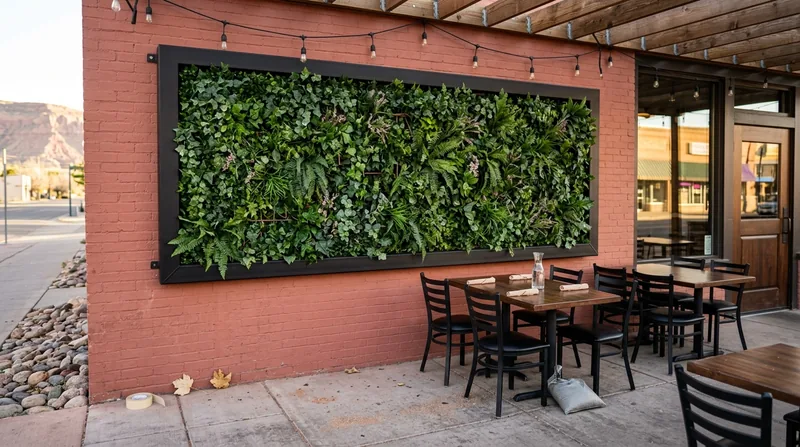




Artificial grass walls and vertical greenery transform blank walls, fences and hardscape into living green surfaces without the watering, pruning or seasonal die-back that plague real climbing vines and ivy in Grand Junction's high desert climate. From the 1950s brick ranches of central Grand Junction to the newer stucco subdivisions on the Redlands and out toward Fruita, homeowners face intense sun exposure, alkaline adobe soil, and spring winds that stress real plants. A vertical turf installation adds privacy, sound dampening, visual interest and a cooling effect around patios, pool decks, balconies and fence lines, while staying lush year-round without the water bill or the pest pressure that comes with live vegetation. We install synthetic turf walls on wood, metal, composite and concrete substrates, using proper drainage underlay, professional-grade adhesive and turf products rated for vertical application. The work is fast, permanent and transforms a bare or weathered surface into an asset that lasts.
Why Artificial Grass Walls Matter in Grand Junction's Outdoor Living
Grand Junction sits between the Colorado National Monument's red-rock walls and the grey Book Cliffs, in a landscape where real vines, ivy and climbing plants struggle against drying winds, intense UV, and irrigation water that shuts off in fall. Many homeowners invest in patio covers, pergolas and pool decks only to find that climbing vegetation either dies back or requires constant feeding and maintenance. Vertical turf solves that problem: it stays green, requires no soil, no fertilizer, no pest control and no seasonal replanting. A turf wall also absorbs sound, reduces glare and heat reflection off concrete or stucco, and creates an instant backdrop for entertaining or outdoor dining without the 2-3 year wait for a real vine to mature.
- We mount artificial turf on existing walls, fences and hardscape using a moisture-resistant underlay and turf-rated adhesive rated for vertical load and UV.
- Turf walls drain internally so water doesn't pool or cause substrate rot, and they shed rain quickly in spring storms.
- A vertical turf installation requires no soil amendment, no planting holes, no root barriers and no ongoing pruning or training.
- Turf walls work in full sun, deep shade and partial shade, unlike many real vines that need specific light conditions to thrive.
- The finished surface is soft underfoot on lower sections, safe for children and pets, and adds a natural aesthetic to modern or traditional homes.
In a climate where real ivy often succumbs to spider mites, powdery mildew or freeze damage, a turf wall is a low-risk way to add greenery to a property that actually stays green.
Key info: Turf walls on south-facing surfaces in full sun can absorb and radiate heat, so we recommend lighter turf colors, cooling infill options and a water rinse on hot days if the wall is near seating or a pool deck. A north-facing wall or one shaded by trees stays cool naturally.
How We Install Artificial Grass Walls in Grand Junction
Installing turf on a vertical surface requires different technique than laying turf on the ground. We start by evaluating the substrate, checking for cracks, rot, loose paint or stucco, and ensuring the surface is sound and dry. We then apply a moisture-barrier underlay, secure it with fasteners or adhesive rated for the substrate material, and attach the turf using specialized vertical-grade adhesive and mechanical fasteners at the top edge and seams. Proper drainage is critical: we slope or perforate the underlay so water runs off rather than pooling behind the turf. The finished edge is sealed and trimmed so no underlay or substrate shows. This work demands precision and care, and we measure and mock up before we commit adhesive.
- We inspect the wall or fence for structural soundness, cracks, moisture, loose material and prior damage that must be repaired before turf is attached.
- We clean and prepare the surface, removing dirt, algae, loose paint and any debris that would prevent adhesive from bonding.
- We install a moisture-resistant underlay designed for vertical surfaces, securing it with fasteners or adhesive appropriate to the substrate.
- We cut and fit the turf to the exact dimensions, positioning seams for minimal visibility and maximum durability.
- We apply turf-rated adhesive in a controlled pattern and press the turf firmly against the underlay, working out air pockets.
- We secure the top edge and seams with mechanical fasteners or additional adhesive, and seal edge trim so no underlay is exposed.
- We test the installation for adhesion and drainage, and rinse the turf to remove dust and leave it ready to use.
A wall or fence turf job typically takes 1 to 3 days depending on size, substrate condition and weather. We also handle patio and balcony turf on horizontal hard surfaces using the same drainage and adhesive principles.
Example: A homeowner in Orchard Mesa with a 12-foot privacy fence between two properties wanted to add visual interest and block the view of a neighbor's driveway. We installed a 4-foot-high turf wall along 60 linear feet of the fence using a lightweight underlay and professional adhesive. The turf stayed green through the hot summer and the first freeze, and the sound dampening made the patio noticeably quieter.
Methods and Materials for Vertical Turf Installation
| Approach | Description | Best for |
|---|---|---|
| Full-height fence wall | Turf mounted from ground to top of fence or wall, typically 4 to 8 feet high, covering the entire visible surface. | Privacy screens, sound barriers, visual transformation of weathered or unattractive fences in residential yards. |
| Partial or accent wall | Turf applied to a section of a wall or fence, often 3 to 5 feet high, creating a green accent or focal point. | Patio backdrops, pool deck backgrounds, gated entry features, areas where full coverage is not needed. |
| Overhead or pergola turf | Turf applied to the underside of a pergola, overhang or shade structure, creating a living ceiling effect. | Shaded entertaining areas, covered patios, carports and structures where overhead greenery adds visual softness without real vine maintenance. |
| Balcony or railing turf | Turf attached to the face or infill of a balcony railing, creating privacy and a green appearance from adjacent properties or streets. | Multi-unit residential, condos, townhouses and apartments where privacy and aesthetics matter and real climbing plants are prohibited or impractical. |
| Planter box or raised bed turf | Turf applied to the outer face of a planter or raised bed, integrating the container into the green wall design. | Mixed landscape designs, commercial entries, areas where a combination of real plantings and turf creates depth and visual interest. |
Artificial Grass Walls and Vertical Greenery Cost in Grand Junction: What to Expect
The cost of a turf wall installation in Grand Junction starts at around $18 per square foot and can range to $25 to $30 per square foot or higher depending on several factors. The substrate condition is the biggest driver of cost: a clean, sound, flat wall costs less than one with cracks, rot, loose material or prior damage that must be repaired first. The height and linear footage matter as well: a small accent wall 4 feet high and 10 feet wide is faster and cheaper than a full 8-foot privacy fence running 100 feet. Access also affects price, because difficult-to-reach surfaces require scaffolding, lifts or additional labor. The turf product itself varies in price based on face weight, pile height and infill type, and we specify those in writing before we start.
A typical residential turf wall project, say 50 to 100 linear feet at 4 to 6 feet high on a sound substrate, falls between $3,600 and $7,200. Larger commercial projects or walls with substrate prep, structural repairs or complex geometry can be higher. We always measure on site and provide a written estimate that breaks down turf cost, underlay, adhesive, labor and any prep work required. Our full pricing page gives ranges for different project types, and you can call us at (970) 438-2585 for a free estimate.
- Substrate condition and repair needs are the largest cost variable, because a cracked or rotting wall must be fixed before turf is applied.
- Linear footage and height determine the square footage, which drives the turf and adhesive cost.
- Access and working height matter: a 3-foot fence wall is faster than a 8-foot privacy fence that requires a lift or scaffolding.
- Turf product selection, face weight and infill type affect the per-square-foot rate and the long-term durability of the installation.
- Seam placement and complexity add labor if the wall is large or has obstacles like vents, outlets or architectural features.
Getting 2 to 3 estimates from different turf installers ensures you understand the scope and the pricing, and you can compare the products and techniques each company proposes.
What to Look for When Hiring a Turf Installation Company Near Grand Junction
Choosing the right turf installer for your wall project is as important as choosing the right product. Many crews in the Grand Junction area lay turf on bare dirt or apply it to walls without proper underlay or adhesive, and the result is seams that separate, turf that lifts, and water damage to the substrate behind. You want a turf installation company that knows the local climate, understands vertical installation technique, and puts the work in writing. Here is what to verify before you hire.
- Ask for a certificate of insurance naming general liability and workers compensation coverage, and verify it is current and in force.
- Request a written specification that names the turf product, face weight, pile height, infill type and pounds per square foot, the underlay type and thickness, the adhesive product, and the substrate prep and base depth.
- Ask for references from recent wall or vertical turf projects in Grand Junction, Fruita, Palisade or Orchard Mesa, and call or visit at least two to see the finished work.
- Confirm the company has a local address and phone number, and that they respond to your calls and emails within 24 hours.
- Check whether the company has worked on turf walls in your neighborhood or on similar substrate types (stucco, wood, composite, metal) and ask about lessons learned.
- Discuss HOA rules or architectural guidelines that may apply to your wall, and confirm the company can work with your HOA if approval is required.
- Ask about the warranty on the installation work itself, and understand that this covers labor and adhesive only, not the turf product or infill.
A turf installer that takes time to understand your site, provides a detailed written estimate, and can show you finished work in your area is worth the conversation. Call us at (970) 438-2585 or visit our contact page to schedule a free estimate and see how we approach wall turf in Grand Junction.
Artificial Grass Walls & Vertical Greenery in Grand Junction: Pricing Guide
| Service | Price | Details |
|---|---|---|
| Partial or accent wall turf | Starting at $18/sq ft | Small to medium walls up to 200 sq ft on sound, clean substrate, includes underlay, adhesive and labor |
| Full-height privacy fence or large wall | Starting at $20/sq ft | Larger installations 200 to 500 sq ft, substrate prep and proper drainage underlay included, seam placement optimized |
| Overhead, pergola or complex geometry | Starting at $24/sq ft | Difficult-to-reach or horizontal-overhead surfaces requiring scaffolding, lifts or specialized installation technique |
| Substrate repair or prep | On estimate | Walls with cracks, rot, loose material or prior damage must be evaluated on site before adhesive is applied |
| Travel and site visit | Included | in Grand Junction and surrounding areas, no separate mileage or travel charge |
| Free estimate | No charge | Response within 24 hours at (970) 438-2585, on-site measurement and written specification included |
Indicative pricing, the exact cost depends on square footage, finish, and site access. Free personalized estimate within 24h at (970) 438-2585.


